



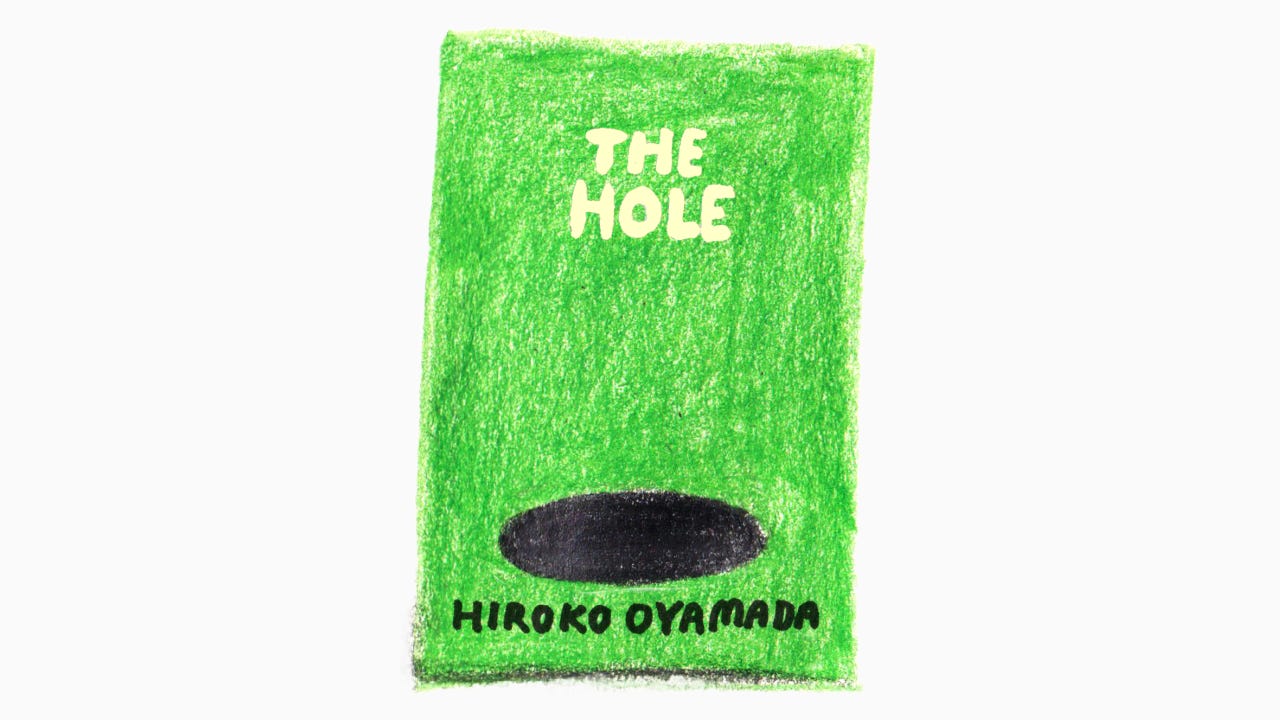
Hiroko Oyamada’s second novella is called The Hole, but – really – the title could be pluralised: this book is punctuated by not one but many holes, literal and figurative. When our central protagonist, Asahi, falls into a hole, she observes: “The hole felt as though it was exactly my size – a trap made just for me.” But her story is also riddled with inconsistencies, gaps, and omissions: there are plot holes and plotholes.
The question is: can she trust her own memory?
Welcome to the dream-like world of Japanese literature which, according to The Spectator, accounted for a whopping 43% of top translated fiction sales last year. Readers have collectively fallen into ~a hole~ of Japanese writing which challenges Western notions of storytelling, pushing the envelope of what a narrative can or should look like… then posting that envelope into a different dimension entirely. Unbound by the Western rulebook, these stories are often contemplative and slow-paced, containing microscopic detail of characters’ movements and ponderings, sometimes with preternatural elements. In Japanese fiction, reality isn’t rigid but fluid.
Sometimes these novels are described as “cozy” but I think that can be misconstrued as reductive, implying they are simple and unperceptive. Far from it. Yes, these stories linger on the mundane aspects of everyday life, but this establishes verisimilitude and believability. When unusual aspects are introduced, they’re not too difficult to embrace, since the minutiae of society is otherwise so convincing. Characters’ qualms and grievances often represent those of the average citizen, so when strange or bad things befall them it’s all the more poignant.
The ordinary:
Jane Lawson, deputy publisher at Doubleday, summed up what readers were uncovering in Japanese literature that they hadn’t previously encountered in the English-speaking world: “In Japanese fiction, readers are finding comforting stories about ordinary lives transformed by small adjustments of attitude, suggesting positive change is something we can all reach, if we are open to it.” [Quote from The Booker Prize website]
